In a few short years, the Circular Economy has gone from obscurity in Australia to targets and policy, with 2024’s Australia’s Circular Economy Framework setting out a goal of doubling circularity by 2035.
Is industry moving quickly enough to seize on the opportunities, though? What are some standout examples? What can be learned from them? And what can be said of our progress away from the old take-make-waste model?
Join us for a practical exploration of Circular Economy principles; key business models and enablers; examples of the concept in Australia and internationally; an introduction to targets, policies, metrics and strategies; how to be a leader and inspire change; and more.
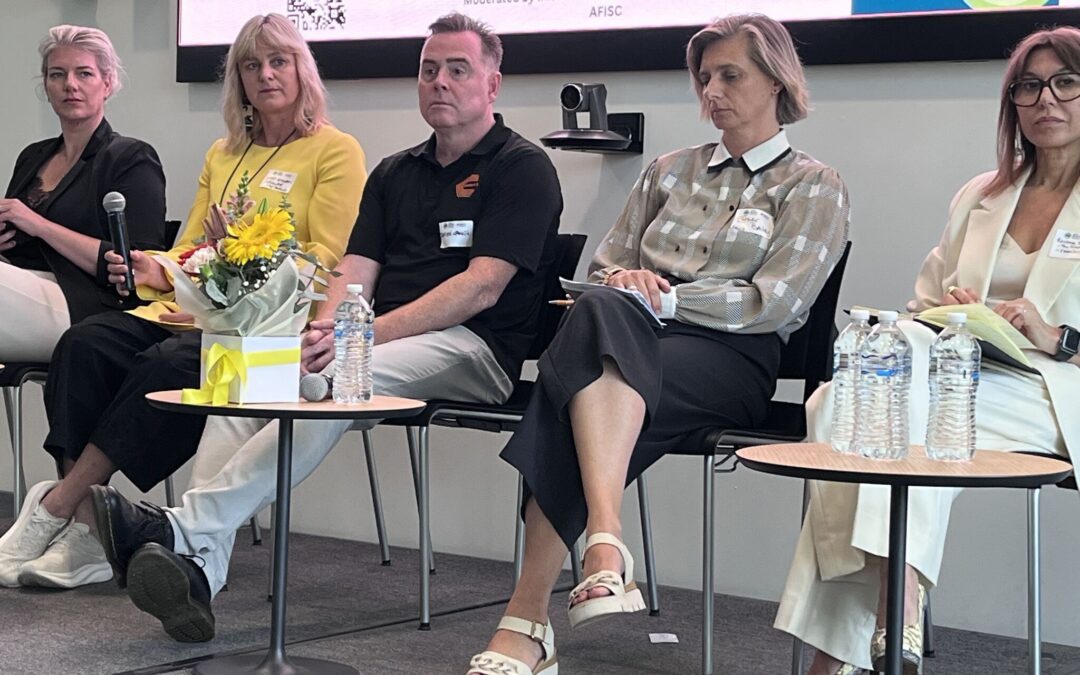
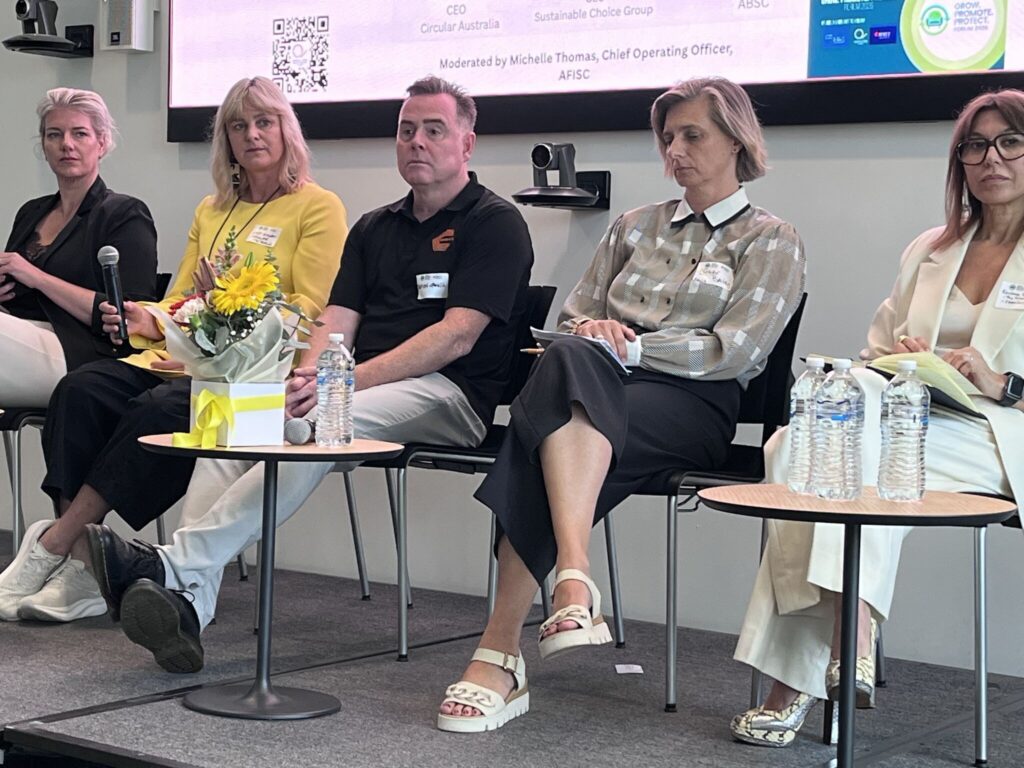
Our expert panellists are Esther Bailey, Chief Operating Officer at Rebuilt; Damien Crough, Executive Chairman at prefabAUS; Rosanna Iacono, CEO, The Growth Activist; Lisa McLean, Managing Director & CEO, Circular Australia; Kylie Roberts-Frost, CEO, Australian Bedding Stewardship Council.
The discussion is moderated by Michelle Thomas, Chief Operating Officer, AFISC . Scroll down for streamable audio of the session, which is also available to download via Apple Podcasts, Spotify, and other platforms.
Esther Bailey – Rebuilt
Esther is an experienced sustainability leader, innovator and changemaker with many years’ experience in the public and private sectors.
She works with business, technology, peak bodies, state and federal government to increase the sophistication and urgency of our response to climate change with a current focus on ambitious action towards net zero emissions in building products. Esther leads teams that provide carbon assessment and verification, ratings, advisory services and software solutions. These inform building regulation, ESG compliance, market insights, circular economy solutions and net zero pathways to deliver short term benefits that lead towards long-term transformation.
Damien Crough – prefabAUS
Damien is a founding Director and the Executive Chair of prefabAUS – the peak industry body for prefabricated and offsite construction in Australia. PrefabAUS has been operating for more than a decade and has over 185 member companies (600+ individuals) nationwide.
Damien works with several universities and research bodies to explore advanced manufacturing technologies and collaborates with government and industry bodies to advance the prefabricated building (smart building) industry in Australia. Damien sees strong opportunities for the prefabrication industry to set itself apart by providing low waste, high quality, sustainable and design led alternatives.
Rosanna Iacono – The Growth Activists
As CEO of The Growth Activists, Rosanna delivers whole-of-business ESG, sustainability and circular economy strategies. She is a B Lab-trained B Consultant and GRI-trained practitioner, Independent Chair of Seamless (the National Clothing Product Stewardship Scheme Transition Advisory Group), Co-Chair of the Australian Fashion Advisory Board, and a member of the Australian Fashion Council’s Circular Economy Leaders Advisory Board. Rosanna is also a contributing foresight analyst with The Future Laboratory, a national ambassador for Heads Over Heels, and an AICD-trained director with a strong commitment to stakeholder capitalism, women’s rights and children’s rights.
Kylie Roberts-Frost, Australian Bedding Stewardship Council
Kylie Roberts-Frost is CEO of the Australian Bedding Stewardship Council and has a career spanning logistics, sustainability, and leadership across sectors. Kylie has worked from the ground up, shaping her leadership style and understanding how every role fits into the bigger picture. In logistics, she built a strong foundation with Maersk, MSC, and UASC. At Deloitte, she shifted into strategy, advising on global supply chains and business growth, before pivoting to sustainability, leading impactful work at social enterprise Soft Landing. She recently found herself being referred to as “The Mattress Lady”, having a giggle at first before deciding to embrace it. For Kylie, it’s about utilising stewardship to demonstrate that the circular economy is possible, and showing that we can achieve social and environmental outcomes without compromising commercial realities. If being “The Mattress Lady” helps start those conversations, she’s all for it.
Lisa McLean – Circular Australia
Lisa is a global circular economy and zero-carbon business transformation leader. She is an international speaker and author of circular economy publications supporting businesses and governments in the circular transition. Lisa has been successfully advising industry and governments in developing new policy frameworks, regulations and tools to bring about market change enabling the circular economy, over the past 20 years. This work covers markets, supply chains and business models across the water, energy mobility, finance and investment sectors in Australia and globally.
Episode guide
0:02 – Introduction to the session.
1:52 – Introduction to the panellists.
4:52 – Why procurement is important to lifting circularity outcomes.
5:45 – Australia’s “ridiculously low” current circularity rate.
8:22 – Prefabrication/modern methods of construction as an enabler of profitability in the building sector.
9:00 – Design for manufacture, assembly and disassembly in construction.
10:05 – You take waste out by working with your supply chain.
11:20 – The smart building value chain and the seven links within that, led by design and planning.
14:20 A project between prefabAUS and RMIT University for architects developing a tool for architects to make better purchasing decisions.
14:45 – The issue of mattress waste and voluntary vs mandated stewardship.
15:50 — “We can’t recycle our way out of this.”
16:55 – Where the burden of waste stewardship sits.
17:50 – The economics of stewardship. What mandates mean for commercial sustainability.
19:40 – An explanation of EPR. If you’re responsible for what happens at a product’s end of life, then you’ll design it accordingly.
21:05 – Embodied carbon and reporting and how it’s changing expectations.
22:40 – The importance of peak bodies in the circularity/decarbonisation discussions.
27:10 – Using sustainability credentials strategically to differentiate from fast furniture.
30:05 – Starting with the big picture before narrowing down to practical implementation. Plus four pillars to stewardship.
32:02 – The importance of a maturity audit.
33:20 – Getting into “pilot scale and repeat” mode.
34:25 – “If it’s not in your design guidelines and not in your procurement guidelines, it’s just a wish.”
35:40 – The importance of ESG in talent engagement, attraction and retention.
37:02 – A question from the floor on latex mattresses, recyclability and EPR.
40:40 – A question from the floor on mattresses and a servitisation business model.
42:39 – Circular businesses, products-as-a-service and financial measures.
44:12 – The sources of embedded carbon in products. Materials are number one and facility power is two.
45:20 – Why servitisation is the future for construction.
47:50 – “The end of ownership” and attitude shifts among young people.
48:50 – Taking back products and closing the loop, and some of the difficulties around this.
51:10 – The challenges around logistics and costs have seen steel amounting to “over 3,000 tonnes in Queensland in the last 12 months” landfilled rather than recycled by Infrabuild, Bluescope or others. “A national disgrace.”
52:50 – “Recycling is the hero of the linear economy”.
53:10 – A question from the floor on recycling claims versus what is actually recycled.
54:30 – “One of the biggest examples of greenwashing we have in the retail space…”
56:55 – Remanufacturing is inexplicably tied to local recycling. An example of this in the fashion industry, plus the importance of a precinct strategy in this.