
With a competitive local market, Australian manufacturers wanting to scale their business are often advised to chase exports for business growth. It’s never as easy as it sounds, and this era has thrown up some particular challenges around geopolitics and protectionism.
So how do these and other shocks affect furniture makers and those involved in their supply chains? This panel from day one of GPP 2026 gives an explanation of what’s going on in terms of tariffs, trade and tyrants shaping the global market, and how you can adapt to make the most of this moment.
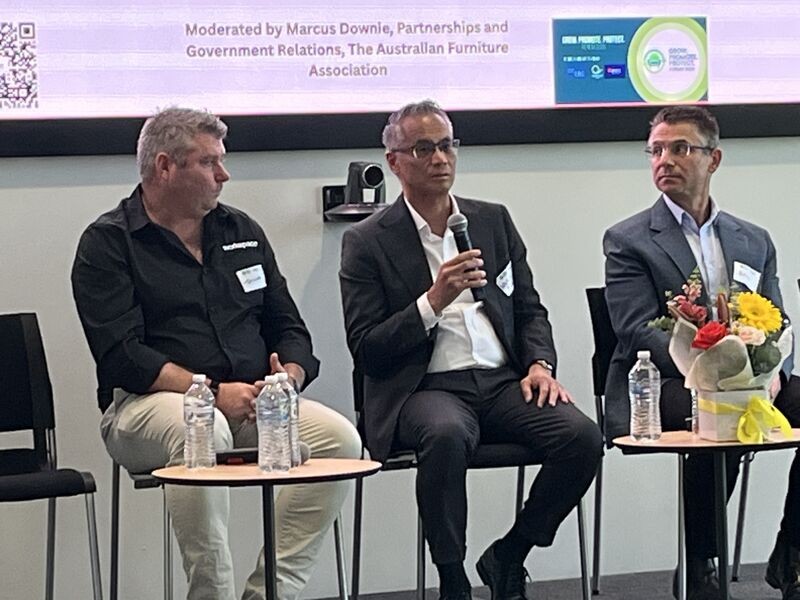
Our expert panellists are Tom Clark, CEO, Workspace Commercial Furniture; Boaz Shiponi, CEO, Nexus Point; Arnold Jorge, CEO, Export Council of Australia.
The discussion is moderated by Marcus Downie, Partnerships and Government Relations, The Australian Furniture Association. Scroll down for streamable audio of the session, which is also available to download via Apple Podcasts, Spotify, and other platforms.
Tom Clark – Workspace Commercial Furniture
Tom Clark is the CEO of Workspace Commercial Furniture, Australia’s largest diversified commercial furniture manufacturer, specialising in delivering project-based solutions across office, education, hospitality, health, aged care, hospitality, accommodation, and defence sectors. With extensive expertise in sustainable manufacturing and design, Tom represents a company with a proud Australian heritage, focused on providing innovative, durable, and functional commercial furniture solutions. His involvement with the ASGF TAC Committee reflects his commitment to fostering collaboration and advancing industry standards in sustainable and certified furniture design.
Boaz Shiponi – Nexus Point
Boaz Shiponi is the Founder and Managing Partner of Nexus Point, a registered tax agent and licensed customs brokerage, and is the organisation’s Managing Director. He is a highly regarded customs and international trade adviser with deep expertise in international supply chain strategy, customs compliance and trade regulation. Boaz is a licensed customs broker, R&D tax agent, and a Graduate of the Australian Institute of Company Directors (GAICD). He holds a Bachelor of Economics and Management and an MBA, and acts as a Non-Executive Director, contributing strategic oversight and governance expertise.
Arnold Jorge – Export Council of Australia
Arnold is a value-based leader, driving organisational transformation through innovative business models, strategic clarity, and trusted partnerships, delivering unique value-adding solutions and diverse revenue streams. He fosters individual development and flexibility to boost team performance.
Arnold has orchestrated successful business turnarounds by enhancing operational efficiency, forming strategic partnerships, and elevating brand reputation. His initiatives have influenced government policies on inclusive and sustainable trade and contributed to the empowerment of women and First Nations entrepreneurs to engage in global trade.
Episode guide
0:02 – introduction to the session.
0:52 – introduction to panellists.
3:36 – Some thoughts on supply chains and their operation.
7:42 – The opportunity that exists relating to overcapacity in shipping and an approaching of “rock-bottom prices”.
9:08 – If you import raw materials, now is the time to pock in prices.
10:38 – Why the Suez Canal matters.
11:50 – The overall cost of freight to a business, a common hidden cost,.and why companies sometimes overpay duty when importing from FTA countries.
13:30 – Tariff concessions and duty planning.
14:24 – Most people do not explore the costs of their freight forwarder, to their detriment.
16:40 – What exporters should consider regarding the US market at the moment.
17:42 – The size of the US furniture market, as well as the current risks attached to selling into that market. Customs officers are taking a “very conservative approach” at the moment, and declaration errors are being treated harshly.
20:30 – A question from the floor on exporting to the US as a raw materials supplier to the furniture industry and the biggest barrier in this.
21:02 – The possible usefulness of a furniture product passport to Australian exporters to the US.
23:10 – Why Workspace Commercial Furniture deliberately decided not to go to the US.
24:14 – Other markets that hold potential for those considering exporting.
25:18 – The upcoming EU FTA, and some of the considerations regarding things such as waste management obligations. Features the example of Bundaberg Ginger Beer sales in Germany.
26:40 – The importance of collecting as much data as possible throughout your supply chain to remain internationally competitive.
27:40 – The adoption of traceability technology in Vietnam. “Almost every small farmer in Vietnam actually uses blockchain.”
29:20 – Auditing a supply chain and the usefulness of this. Why Workspace chose to own its supply chain and why this is critically important.
32:25 – The advantage of Workspace owning its own fleet of delivery trucks. “At the end of the day, if it’s damaged, we did it.”
34:20 – Launching a circular economy division at Workspace and the role in their freight network in this.
36:58 – The tyranny of distance versus export opportunities.
37:42 – Supply chain business development work that overseas countries are doing, specifically China.
39:20 – The skills that are needed currently. Apprentices are the biggest challenge.
40:47 – A question from the floor on sustainability credentials and upstream suppliers.