
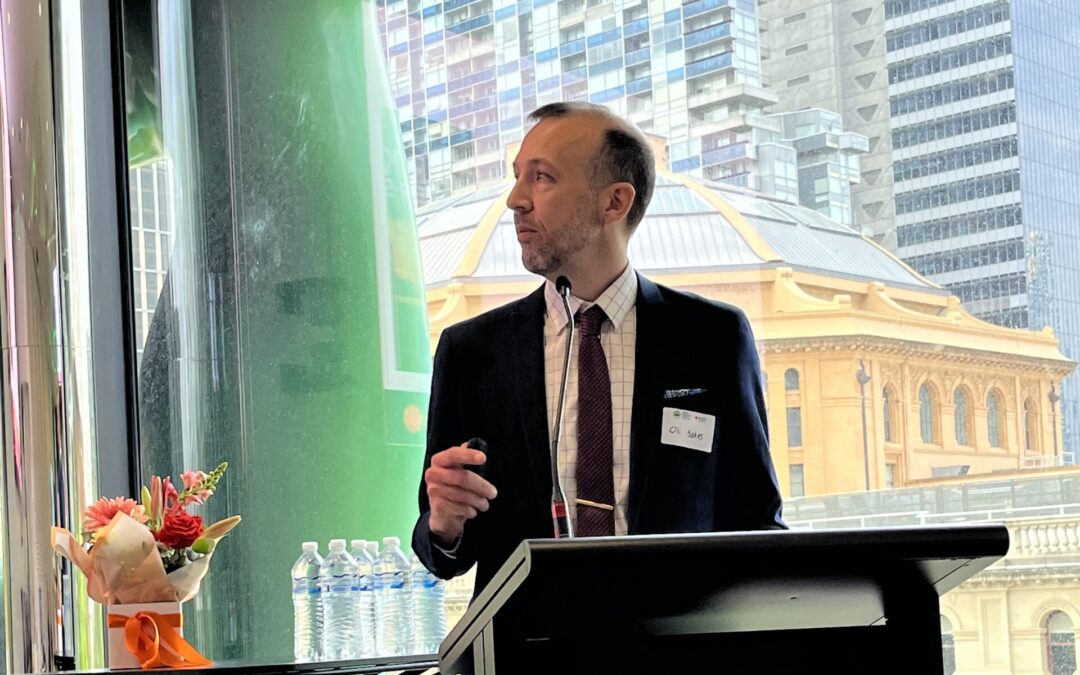
At Grow. Promote. Protect. 2026, Professor Oliver Jones from RMIT University’s Regenerative Futures Institute delivered a briefing on the issue of PFAS, advising that attendees take a nuanced point of view, based on something other than headlines and hype.
As you’ll hear in the lecture (embedded below), some of the key points include:
• Not all PFAS are the same. Definitions matter;
• Dose and exposure determine risk;
• Perception drives regulation and litigation; and
• The “If we don’t test, it’s not a problem” won’t hold up
The message to the furniture sector was simple: If you don’t know what’s in your products, you’re exposed; and if you can prove what’s in them, you’re protected.
Leadership now reduces liability later.
Episode guide
0:02 – An introduction to the day’s keynote speaker, Professor Oliver Jones.
1:55 – The furniture industry and others are dealing with public concern over PFAS.
2:27 – A background in environmental, analytical and biological chemistry and the perspective this brings. Plus a few words on the importance of nuance in this conversation.
3:45 – PFAS hit the stage with the film Dark Waters.
4:28 – What PFAS are, the broadness of the category, some of their uses, and what led to their development.
5:24 – The role of the USS Forrestal incident in this story.
6:10 – Some of the things PFAS are blamed for.
7:45 – PFOA was a type of PFAS that gained attention in Dark Waters and the book Exposure, it’s not the only type. One definition gives about 4,730 potential compounds.
8:19 – The OECD’s revised definition of PFAS gives maybe 7 million possible chemical combinations, and while some of these are purely theoretical, it shows how broad the category is.
9:01 – The US EPA definition of PFAS.
9:30 – One reason PFAS are resistant to degradation.
10:01 – A reason PFAS chemicals can be useful in pharmacology, plus a reason the US EPA decided against an argument on regulations with the FDA, resulting in another definition of PFAS.
11:36 – The Canadian classification, which is similar to the OECD definition bar one difference.
12:28 – Different drugs are regulated differently because they have different risks attached.
13:05 – On “forever chemicals” and why it’s a catchy but misleading description.
14:02 – Exposure data across Australia and USA over time.
15:15 – Testing data being collected in Australia and some of the limitations of this.
16:20 – We’ve never made PFAS in Australia. It’s all been imported.
16:50 – There’s “surprisingly little data on the effects of environmentally-relevant concentrations”.
18:08 – The importance of context when you’re talking about toxicology. All chemicals are potentially toxic at high enough doses.
19:50 – How can you evaluate risks if you don’t have proper data? Everything has risks attached to it, but these vary depending on the situation and the steps taken to mitigate whatever the hazards are.
21:08 – Issues of accumulation.
22:05 – Some of the varied uses of PFAS, and issues outside of environmental ones, such as at the Winter Olympics.
24:20 – Goretex and greenwashing.
25:30 – Teflon is a fluoropolymer, inert, and doesn’t have any proven biological effects.
26:10 – a big issue with the carpet industry in the US.
27:43 – The Senate inquiry into PFAS.
28:30 – Claims in Australia brought by landholders regarding defence sites.
30:05 – Food packaging and cosmetics.
31 – A personal recollection of noise-induced hearing loss claims in England. A lesson that – whatever the merits – people will often try and get money from a large company when there’s an incentive for themselves and lawyers.
31:55 – Legal cases, unfortunately-impacted claimants, sympathetic, non-scientific juries, and payouts.
33:05 – A prediction that there will be more PFAS-related litigation in future.
34:30 – Advice on how to approach the issue of PFAS and potential related liabilities at a company.
35:10 – The furniture industry and what it could do on the subject. “There’s a chance to get ahead of the game.”
38:02 – If you’re able to track your products, their lifecycle, their inputs etc., then there’s value in that.
40:02 – Let’s just be careful to not repeat past mistakes. We’ve seen chemicals get a bad reputation, only to be replaced by other undesirable chemicals to perform a certain purpose.
41:15 – The example of BPA being replaced by BPS, which we know less about toxicologically.
42:30 – A question from the floor about detoxification.
43:10 – A question from the floor about brominated flame retardants.
46:20 – A question from the floor about where FPAS might be used in furniture and how to deal with it when it comes to recycling.
52:28 – A question from the floor about the benefits of PFAS outweighing the risks and if this is something that can be understood.
54:50 – A question from the floor about driving innovation that does no harm.