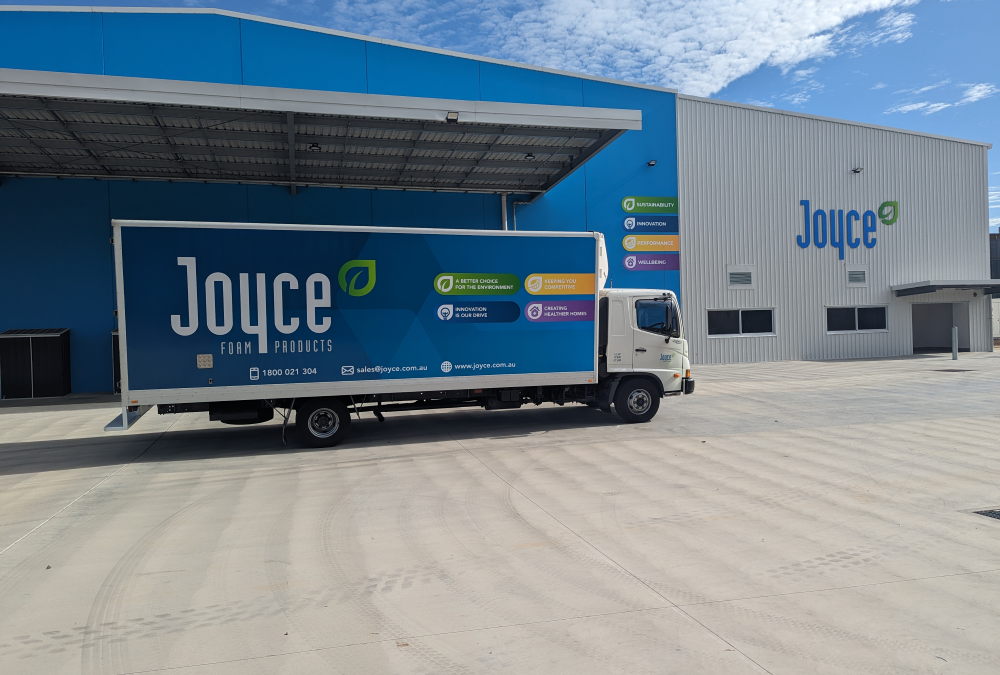
As with manufacturing businesses in general, the circular economy is a growing consideration for Australia’s largest foam maker, Joyce Foam Products, which traces its history back to 1886 as a maker of calico and linen bags.
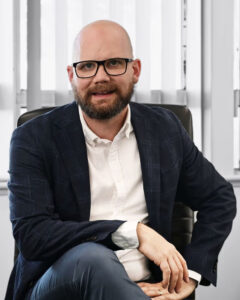
“The context has definitely changed as we start to look further down supply chains at the full product life cycle,” explains the company’s Chief Operating Officer, Kevin Graham.
“The historical view was that, through mechanical recycling technologies, we can capture and recycle all of our postindustrial scraps. So as a business we’ve done our part. In today’s world that’s not enough. We need to start looking fully circular.”
The challenge is elevated by the material Joyce makes – in more than 60 different grades – being a thermoset plastic.
Recycling is one important part (though not the only part) of the circular economy. And while applications and markets for recycled thermoplastics have grown, thermosets remain hard to recycle.
State-of-the-art chemical depolymerisation and pyrolysis methods for recycling polyurethane (PU) are progressing fast, but are not yet properly scalable, says Graham.
Joyce has been specialising in PU since 1953, and produces it at two Australian sites: Moorebank, Sydney and Edinburgh North, Adelaide.
Currently, about 80 per cent of business is in supplying customers for comfort applications, such as sofas, bedding and automotive. Another 12 per cent is in specialty products, including filtration and acoustic control products.
A business-to-business enterprise succeeds by solving both its customers and its customer’s customers’ problems. Graham says that this means understanding the key value drivers of consumers in a particular market and then developing technologies to appeal to those.
“For example, in bedding it would be supporting microclimates, managing heat humidity during sleep – that’s that sweaty sleep that’s uncomfortable,” he adds.
“In furniture it would be consistency of product ensuring that across the life cycle of a sofa, this seat number one stays as consistent or stays the same feel as seat number two. Even if seat number one’s used on a daily basis. And seat number two might be a guest.
“You don’t want your sofa to have three different feels on three different seats.”
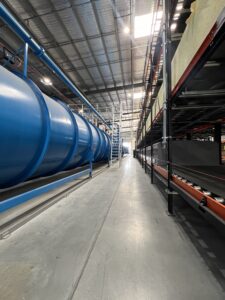
Vital to its competitiveness, says Graham, is the proprietary Variable Pressure Foam (VPF) technique. The two Australian factories each run one of only ten machines in operation worldwide, he adds.
Each machine (pictured above) is “about 150 metres long by 8 metres by 8 metres”, and uses specially-controlled atmospheric pressure to precisely manage the properties of foam without the use of environmentally- and health-damaging auxiliary blowing agents (ABAs.) Activated carbon scrubbers are used absorb VOC emissions prior to opening, delivering a more-or-less emissions-free scenario.
Getting rid of ABAs has helped reduce production-related carbon dioxide equivalent levels by 72 per cent, for the same mix of products, since 2005.
It makes use of the global R&D centre at the head office of Sheela Foam (parent company since 2005) in Delhi, as well as the local Sydney site.
Another benefit of VPF is the ability to innovate products with new properties and fewer additives. A recent example is a 12-month R&D program delivering the Ultimate Comfort range of Combustion Modified High Resilience (CMHR) foams that meet Australian standards without the use of brominated, trisphosphate, or halogenated additives.
“And we did that with a considerably differentiated product. It’s a completely new technology that eliminated liquid fire retardants,” adds Graham.
He describes the R&D to avoid what might be recognised one day as potentially toxic fire retardants as a response to an “exceedingly dynamic market”. As more information is gathered on additives, the accepted toxicity levels can change and chemicals might even get annexed as banned altogether.
There’s also the circular economy movement to consider, for both Joyce and its customers in the furniture and other industries.
PU is already a tricky class of plastics. Having to separate it out from additives as another recycling step makes a tough job tougher still.
Being part of the Australian Furniture Association and the Australian Furniture Industry Stewardship Council gives Joyce access to “great collaboration and a view across the industry” and its regulatory, recycling and other challenges.
“Obviously the spin-off in AFISC, the stewardship program, that’s fundamental for us. It’s a core value that we take ownership not only of our post-industrial scrap, 100 per cent of which is currently recycled, but also as that goes down the supply chain through to end-of-life products,” says Graham.
“We take pride in being a good corporate citizen and ensuring we’re taking responsibility for that. So the Furniture Industry Stewardship Council and being an inaugural member of that is extremely important.”
Pictures: supplied